A pronounced affection for parasites.

According to Peter Olson of the Natural History Museum in London, “All free-living organisms host one or more parasites”. This can be taken two ways, both of them generally true: a) that each individual multicellular organism hosts at least one individual parasite within its body, and b) that each free-living species plays host to at least one species of parasite that attacks it exclusively. Consider this second point for a moment. For each free living species there is one or more (usually several more) parasite species — that is, as a category (polyphyletic, obviously), parasites may very well be the most diverse types of organisms on the planet.

On the other hand, most parasites are much smaller than their hosts, and so it has typically been assumed that they contribute a negligible fraction to any particular ecosystem’s total biomass. Nuh-uh. In a report published in Nature this week, Kuris and colleagues presented five years’ worth of analyses of estuaries in California and Baja California in which they measured the amount of biomass made up of parasites and free-living organisms.

In sum, Kuris et al. (2008) examined 138 species of infectious agents, 199 species of free-living animals (including invertebrates as well as fishes and birds), and 15 species of free-living plants in their study. They found that plants contributed the most biomass to all three of the estuaries they studied, followed by groups such as snails, bivalves, and crabs. Parasites made up only about 0.2% to 1.2% of the animal biomass of each environment, and on average parasite groups had biomasses 1000 times lower than the average free-living group. However, as Kuris et al. (2008) report,

Certain parasitic groups dominated the parasite biomass, reaching levels similar to those of common free-living groups. For instance, the biomass of trematode worms was comparable to that of the fishes, burrowing shrimps, polychaetes or small arthropods. In all estuaries, trematode biomass exceeded bird biomass by threefold to ninefold.

In other words, parasites make up a larger fraction of the living matter in these environments than do the top predators. In particular, parasites that castrate their hosts (i.e., prevent them from diverting resources into reproductive effort) were the most abundant. The world is not fishy or feathery, it is fluky.

So, whereas the famous quote attributed to J.B.S. Haldane that if there is a creator he must have “an inordinate fondness for beetles” still applies, it may be that he has an even more pronounced affection for parasites. Especially the castrating sort.

_____

Kuris, A.M., R.F. Hechinger, J.C. Shaw, K.L. Whitney, L. Aguirre-Macedo, C.A. Boch, A.P. Dobson, E.J. Dunham, B.L. Fredensborg, T.C. Huspeni, J. Lorda, L. Mababa, F.T. Mancini, A.B. Mora, M. Pickering, N.L. Talhouk, M.E. Torchin, and K.D. Lafferty. 2008. Ecosystem energetic implications of parasite and free-living biomass in three estuaries. Nature 454: 515-518.

Update: For more detailed discussions, see Not Exactly Rocket Science and keep your eyes open for a post at The Loom.

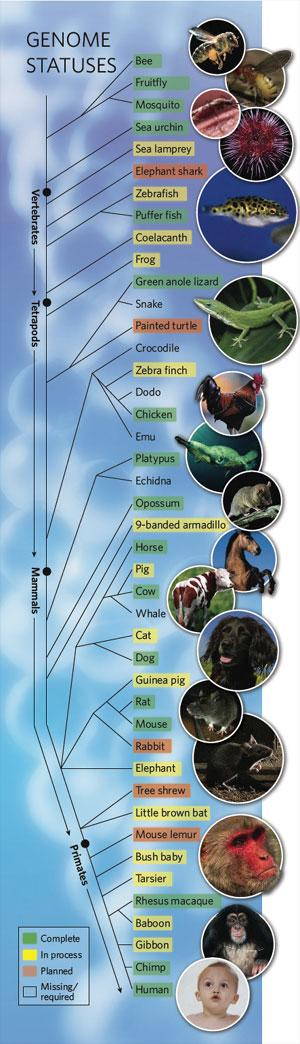
Species-Scape: very cool, but…

Larry Moran directs us to have a look at Species-Scape at the Cornell website. It’s great.

But…

1. It has one group of “prokaryotes”, Kingdom Monera, which is pretty old school. (Same goes for “Protists“). You don’t like dividing the Archaea and Bacteria? Ok, but how about a note that many people now consider this one of the deepest divisions of life? If they can mention something as esoteric to most readers as the phylogenetic species concept, surely they could include a brief line about, you know, phylogenetic groupings at the highest level.

2. And I quote:

This is a taxonomic view of life on earth — based on systematic classifications — which challenges our typical “mammal-centric” understanding of the world around us. Today there is increasing awareness of the enormous diversity of life on earth, but few people probably appreciate the fact that the Species-Scape is completely dominated by multilegged (more than 4 legs) and legless animals, fungi and microbes. Mammals, with a mere 4,000 species, are dwarfed by “lower” animals.

Do we really have to use a misconception to correct a misconception?

HAP DAP.

(Re-posted from Genomicron 2.0)

In one of my snarkier moments, I coined the term “Dog’s Ass Plot” (DAP) in reference to

A graphical representation of data in any field that, through a lack of clear axis labels, selective inclusion/exclusion of data, visual presentation style, and/or other questionable characteristics, generates a misleading interpretation of the data in the viewer, especially by implying an illusory pattern that is not supported by the available data.

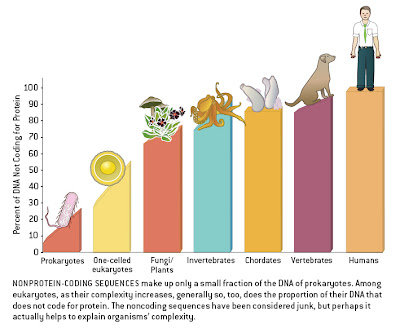
This was based on a figure that purported to demonstrate a relationship between non-coding DNA and complexity.

As I noted,

The sloping of the bars within taxa suggests that this is meant to imply a relationship between genome size and complexity within groups as well, with the largest genomes (i.e., the most non-coding DNA) found in the most complex organisms. This would negate the goal of placing humans at the extreme, as our genome is average for a mammal and at the lower end of the vertebrate spectrum (some salamanders have 20x more DNA than humans). Indeed, the human datum would accurately be placed roughly below the dog’s ass in this figure if it included a proper sampling of diversity.

Now, GraphJam has posted a figure that is not only a superb DAP (i.e., the presentation implies a pattern that extends beyond the data themselves), but a Human’s Ass Plot, or a HAP DAP:

New Educational Model For A New Century

Over at the home of Genomicron 2.0 (ScientificBlogging.com), physicist, education expert, and Nobel laureate Carl Wieman has an important post about 21st century post-secondary science education.

Optimizing The University – Why We Need a New Educational Model For A New Century

There are currently great needs and great opportunities for improvement in post-secondary science education. As world education improves, we need to provide more students with complex understanding and problem solving skills in technical subjects to allow them to be responsible and successful citizens in modern society.

Emerging research indicates that our colleges and universities are not achieving this. However, there are great opportunities to improve this situation using advances in the understanding of how people learn science and advances in educational technology.

The Woodstock of Evolutionary Biology and eye rolling

In a recent issue of Science there was a piece by Elizabeth Pennisi on the "Altenberg 16" who will be attending what overhyping journalist Suzan Mazur calls the "Woodstock of Evolutionary Biology", only it "promises to be far more transforming for the world".

Puh-lease. People have been saying that the Modern Synthesis is neither modern nor a synthesis and needs to be expanded for some time. And there are a lot more than 16 people saying it.

Thankfully, Pennisi uses the nonsensical hype to discuss some relevant issues, and even points out that the people involved themselves do not see it as a revolution.

Massimo Pigliucci is no Jimi Hendrix. This soft-spoken evolutionary biologist from Stony Brook University in New York state looks nothing like that radical hard-rock musician whose dramatic guitar solos helped revolutionize rock 'n'roll. But to Suzan Mazur, a veteran journalist who occasionally covers science, Pigliucci is the headliner this week at a small meeting she believes will be the equivalent of Woodstock for evolutionary biology. The invitation-only conference, being held in Altenberg, Austria, "promises to be far more transforming for the world" than the 1969 music festival, Mazur wrote online in March for Scoop.co.nz, an independent news publication in New Zealand.

That hyperbole has reverberated throughout the evolutionary biology community, putting Pigliucci and the 15 other participants at the forefront of a debate over whether ideas about evolution need updating. The mere mention of the "Altenberg 16," as Mazur dubbed the group, causes some evolutionary biologists to roll their eyes. It's a joke, says Jerry Coyne of the University of Chicago in Illinois. "I don't think there's anything that needs fixing." Mazur's attention, Pigliucci admits, "frankly caused me embarrassment."

My eyes have rolled — and did so again at the sight of this latest report, until I saw that it was much more reasonable.

…no one truly expects a scientific Woodstock. "Woodstock was an immensely popular event celebrating a new musical mainstream," says Newman. "I imagine this will be more like a jam session circa 1962."

I look forward to reading the papers that emerge from the meeting, but I don't expect anything revolutionary — more like some cool ideas to continue discussing.


Did Darwin delay?

In my evolution course, I note that "Darwin spent 20 years working out his ideas and gathering evidence" before releasing On the Origin of Species in 1859. I don't say he "delayed" publication purposely, though in many cases this long period from idea to outcome has been attributed to fear of the reaction from the clergy, colleagues, society at large, his wife, etc. On this issue, a few bloggers have pointed to a recent essay by John van Wyhe (2007), in which it is argued that there was no delay based on fear, only a protracted writing period. Other historians do not necessarily agree, though the blogs I saw did not mention this. As Odling-Smee (2007) says,

…several Darwin scholars are not convinced. Kohn and others agree that the way in which cultural and social pressures influenced Darwin's decisions may have been overplayed, particularly in the public arena, with less attention being paid to the involved process of scientific discovery. But the consensus in the field is likely to remain that a multitude of factors underpinned Darwin's delay.

Kohn points out that searching for explicit references to a "delay" is a simplistic approach to the problem, and that other factors should be considered. For example, Darwin often criticized religion in his notebooks, which suggests that he would have been aware of the probable implications of his theory for religion. It is hard to see how the absence of specific references to a delay rules out any influence of cultural and societal factors on Darwin's decisions, agrees David Quammen, author of The Reluctant Mr Darwin.

Kohn also points out that in Darwin's later publication The Descent of Man, which applied the theory of evolution to humans, Darwin specifically states in the opening lines that he delayed publishing this tome until he was convinced that the climate was right. It seems likely, therefore, that he would have been aware of the controversy his theories would cause from the outset, and probably avoided discussing humans in Origin of Species for this reason.

I think "yes or no" to the question of whether Darwin delayed publication out of fear is very simplistic. Anyone who has written anything of substance knows that sometimes the effect of fear of reaction is procrastination and/or excessive desire to include every piece of information available. Both can cause writing to take longer than it otherwise would. Was Darwin thorough? Yes. Is that one reason it took so long? Undoubtedly. Was he so thorough because of a fear of reaction? Probably at least in part.

_______

Odling-Smee, L. 2007. Darwin and the 20-year publication gap. Nature 446: 478-479.

Van Wyhe, J. 2007. Mind the gap: did Darwin avoid publishing his theory for many years? Notes and Records of the Royal Society 61: 177-205.


A few more quotes about non-coding DNA.

Just for fun, here are some quotes I came across while reading a few sources for a paper I am writing.

Remember, a significant number of creationists, science writers, and molecular biologists want us to believe that non-coding DNA was totally ignored after the term “junk DNA” was published in 1972, that the authors of the “junk DNA” and “selfish DNA” papers denied any possible functions for non-coding elements, and, in the case of creationists, that “Darwinism” is to blame for this oversight. The latter of these is nonsensical as the very ideas of “junk DNA” and “selfish DNA” were postulated as antidotes to excessive adaptationist expectations based on too strong a focus on Darwinian natural selection at the organism level.

For those of you who didn’t read the earlier series, see if you can guess when these statements were made.

(A)

There is a strong and widely held belief that all organisms are perfect and that everything within them is there for a function. Believers ascribe to the Darwinian natural selection process a fastidious prescience that it cannot possibly have and some go so far as to think that patently useless features of existing organisms are there as investments for the future.

I have especially encountered this belief in the context of the much larger quantity of DNA in the genomes of humans and other mammals than in the genomes of other species.

Even today, long after the discovery of repetitive sequences and introns, pointing out that 25% of our genome consists of millions of copies of one boring sequence, fails to move audiences. They are all convinced by the argument that if this DNA were totally useless, natural selection would already have removed it. Consequently, it must have a function that still remains to be discovered. Some think that it could even be there for evolution in the future — that is, to allow the creation of new genes. As this was done in the past, they argue, why not in the future?

(B)

A survey of previous literature reveals two emerging traditions of argument, both based on the selectionist assumption that repetitive DNA must be good for something if so much of it exists. One tradition … holds that repeated copies are conventional adaptations, selected for an immediate role in regulation (by bringing previously isolated parts of the genome into new and favorable combinations, for example, when repeated copies disperse among several chromosomes). We do not doubt that conventional adaptation explains the preservation of much repeated DNA in this manner.

But many molecular evolutionists now strongly suspect that direct adaptation cannot explain the existence of all repetitive DNA: there is simply too much of it. The second tradition therefore holds that repetitive DNA must exist because evolution needs it so badly for a flexible future–as in the favored argument that “unemployed,” redundant copies are free to alter because their necessary product is still being generated by the original copy.

(C)

These considerations suggest that up to 20% of the genome is actively used and the remaining 80+% is junk. But being junk doesn’t mean it is entirely useless. Common sense suggests that anything that is completely useless would be discarded. There are several possible functions for junk DNA.

(D)

There is a hierarchy of types of explanations we use in efforts to rationalize, in neo-darwinian terms, DNA sequences which do not code for protein. Untranslated messenger RNA sequences which precede, follow or interrupt protein-coding sequences are often assigned a phenotypic role in regulating messenger RNA maturation, transport or translation. Portions of transcripts discarded in processing are considered to be required for processing. Non-transcribed DNA, and in particular repetitive sequences, are thought of as regulatory or somehow essential to chromosome structure or pairing. When all attempts to assign a given sequence or class of DNA functions of immediate phenotypic benefit to the organism fail, we resort to evolutionary explanations. The DNA is there because it facilitates genetic rearrangements which increase evolutionary versatility (and hence long-term phenotypic benefit), or because it is a repository from which new functional sequences can be recruited or, at worst, because it is the yet-to-be eliminated by-product of past chromosomal rearrangements of evolutionary significance.

(E)

This is what I emphasized earlier, that this DNA must have a functional value since nothing is known so widespread and universal in nature that has proven useless.

(F)

I’ve stopped using the term [‘junk’] …Think about it the way you think about stuff you keep in your basement. Stuff you might need some time. Go down, rummage around, pull it out if you might need it.

Answers to be provided in the comments.