Another, um, good reason to care about genome sizes.

You denizens of the science blogosphere probably will have heard about the, shall we say, “questionable” article by Donald Williamson (and communicated by Lynn Margulis) in PNAS, in which he claimed that insect larvae arose via hybridization between non-metamorphosing ancestral insects and Onychophora (velvet worms).
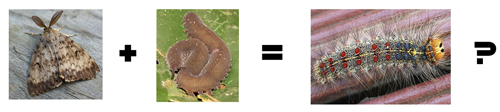
hybridcatsMaybe this sounds silly to you.  Me too.  It also sounded silly to Hart and Grosberg (2009), who thoroughly debunk the hypothesis using data that were already easily available.  You can read a play by play of the refutation over at Jerry Coyne’s blog  Why Evolution Is True and in Scientific American.

So, if it’s already been discussed on a popular blog, why bring it up again?  Because this one relates directly to my area of research, and the subject of many a post here on Genomicron — genome size.

One of the “predictions” given in Williamson’s paper is that species of insects with complete metamorphosis (holometabolous development) will exhibit evidence of a merger of insect and onychophoran genomes, and thus have larger DNA amounts.  It so happens that a) this is bass-ackwards, and b) it is easy to find this out by checking my Animal Genome Size Database (which is what Hart and Grosberg did) or my paper in Genetica from 2002 or my book from 2005 or pretty much any decent paper on insect genome sizes in the last several years.

metamorph

From Gregory (2005).

I often have to summarize reasons why people should care about genome size, as when preparing grant applications.  I never thought that I could add to this list, “refuting nutty hypotheses about the origins of caterpillars”.  I won’t, though, even if many of the data used in the comparison were generated by me or my students (including pretty much all the Lepidoptera estimates).

But, on a more positive note, this flap did draw attention to velvet worms, which are pretty cool:


_________

References

Gregory, TR. 2002. Genome size and developmental complexity. Genetica 115: 131-146.

Gregory, TR. 2005. Genome size evolution in animals.  In: The Evolution of the Genome, ed. TR Gregory.  Elsevier, San Diego, p. 3-87.

Hart, MW and Grosberg RK. 2009. Caterpillars did not evolve from onychophorans by hybridogenesis.  Proc. Natl. Acad. Sci. USA, in press.

Williamson, D.I.  2009. Caterpillars evolved from onychophorans by hybridogenesis. Proc. Natl. Acad. Sci. USA 106:15786–15790.

Nature vs. hype.

From today’s Nature, an editorial entitled Mind the spin:

Scientists — and their institutions — should resist the ever-present temptation to hype their results.

[skipping to the money quote…]

…the temptation for scientists and their institutions to spin their research to the media, or to go publicity-mongering, is always there. And — as illustrated by the excessive public-relations campaign surrounding Ida, a fossil presented as a missing link in human evolution — too many in the media will buy into the initial hype.

Such behaviour is corrosive to the process of scholarly scientific communication. Research institutions must not allow it to become the norm.

Science by press release, but still interesting…

No paper out yet, and not even any details made available, but this looks interesting:

Reduced genome works fine with 2000 chunks missing

To put a figure on how much of our DNA is non-essential, Vrijenhoek and his colleagues screened the genomes of 600 healthy students, searching for chunks of DNA at least 10,000 base pairs in length that were missing in some individuals. Across all the genomes, about 2000 such chunks were missing – amounting to about 0.12 per cent of the total genome.

Some people will over-interpret this as strong evidence for a majority of “junk DNA”. Comprising only 0.12% of the genome, it isn’t. However, as these are natural deletions >10kb, it gets around the objections to the deletion studies (i.e., that the conditions in the lab weren’t the same as the challenges faced in the wild). Then again, it may be that you can have one or two deletions and be ok because there is some redundancy, but if you were missing all of these bits you’d be in trouble. Others will dismiss it as an artifact or somehow not really testing the claim (read: dogmatic assumption) that all DNA is functional, but what else is new.

Are humans still evolving?

Yep, according to a study coming out in PNAS and supported by NESCent.
(As usual, the news comes out before the PNAS article is actually available, so I can’t comment on the study).

Are Humans Still Evolving? Absolutely, Says A New Analysis Of A Long-term Survey Of Human Health

Byars, S., D. Ewbank, et al. (2009). Natural selection in a contemporary human population. Proceedings of the National Academy of Sciences 106, in press.

More microbial art.

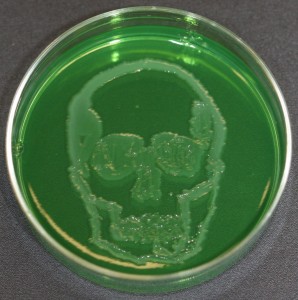
As I mentioned in my previous post, my students and I have been experimenting with creating art from living colonies of bacteria:


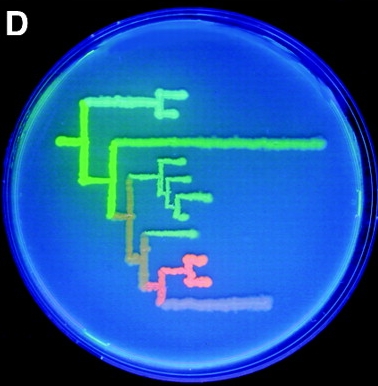
I don’t think this is a common art form (though it’s one I want to explore in more detail down the road), but I am aware of a few other very intriguing examples of similar things.  For example, here are some of the stunning bacteria images by Dr. Eshel Ben-Jacob:


See more of Dr. Ben-Jacob’s artwork.

And here are some using fungi and bacteria by Dr. Niall Hamilton:


See more of Dr. Hamilton’s artwork.

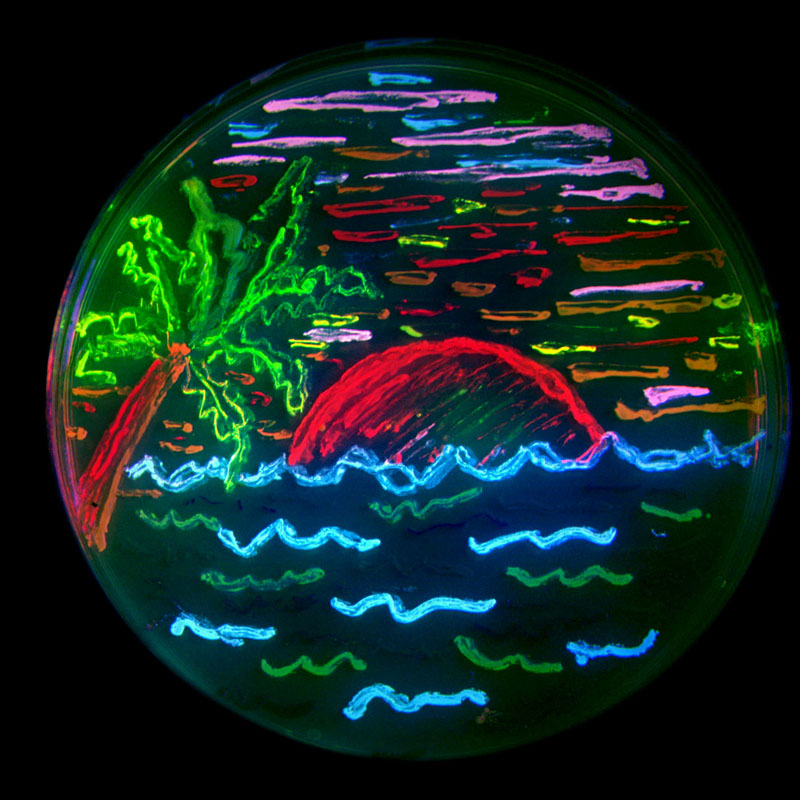
And, of course, this famous image by Dr. Roger Tsien, who won a Nobel Prize for his work on green fluorescent protein:


Or these reconstructed ancestral coral pigments spliced into bacteria by Dr. Mikhail Maltz:

zse0340428030001


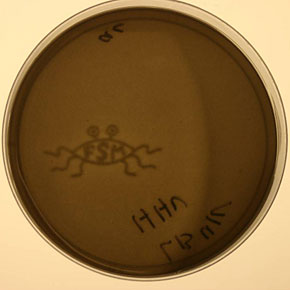
And some “photography” with genetically engineered bacteria by Dr. Chris Voigt:

dish


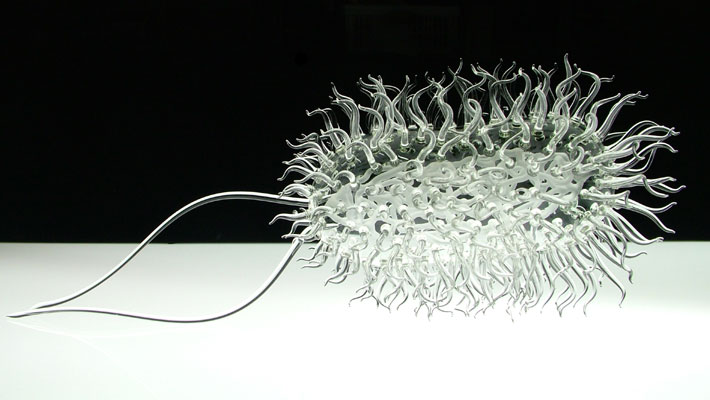
In addition to working with actual bacteria and fungi, there are amazing works of art that depict microbes, such as the bacteria and viruses by Luke Jerram:


[youtube]http://www.youtube.com/watch?v=hhWgq8622Mw[/youtube]

See more Glass Microbiology by Luke Jerram.

If you know of other examples of microbial art, please share.

Evolution and art.

From Oct. 9-30, the University of Guelph and Ed Video are hosting a special art exhibit entitled “This View of Life: Evolutionary Art for the Year of Darwin“. It was organized by professors in four departments: Integrative Biology, Philosophy, History, and English and Theatre Studies, and was curated by Scott McGovern of Ed Video. The exhibit features art by 10 artists, all inspired by the themes of evolution, Darwin, and biodiversity. The Gregory Lab contributed some installations as well, which are shown in this brief clip from just before the opening reception on Oct. 16 (about 200 people attended the event). The first window shows live Daphnia magna (“water fleas”) to depict the concept of overproduction; they also are of interest because they reproduce asexually (the evolution of sexual reproduction being an important question in evolutionary theory). The second window presents images created using live colonies of E. coli bacteria. These last only a few days, so many different images will be displayed throughout the exhibit. The third window shows a projection of a remarkable collection of images of bacterial colonies kindly provided by Dr. Eshel Ben-Jacob.

Here are some more photos of the artwork:

[album: http://www.genomicron.evolverzone.com/images/albums/EvolArt/]

Special thanks to everyone involved in organizing the exhibit, to the artists, and to the following graduate students who are talented artists in their own right: Joao Lima, John Wilson, Tyler Elliott, Paola Pierossi, Nick Jeffery.