"Basic research is the lifeline of practical advances".

Unfortunate though it is, we in the scientific community seem to have to justify regularly the “relevance” of basic, or curiosity-driven, research. Case in point, the February 2008 issue of the CAUT Bulletin has a commentary by Vern Paetkau who makes the point once again that basic research underpins most future advances in applied science. I will let Dr. Paetkau speak for himself by simply referring you to his piece, which can be found here. I will, however, re-quote what I think is a superb point by Nobel laureate Arthur Kornberg:

“No matter how counter-intuitive it may seem, basic research is the lifeline of practical advances in medicine and pioneering inventions are the source of industrial strength.”

Scientists know this, but those with control of the funds often do not see it this way — and that’s a big problem for everyone, not just researchers.


Nature on the plight of Canadian science.

I love Canada. Yes, I know, we’re all human beings and national boundaries are mostly arbitrary, but I am proud of my country and its approach to its citizens and the world. I have lived in the United States and I have lived in England and I appreciated many things about both, but I am glad to be home again. I can think of no other place I would rather live.

I also love science. There are easier jobs, and higher paying ones, but there is nothing better in my mind than spending time pursuing whatever interests me, learning about how the world is and why it is that way, and sharing that knowledge — some age-old, some brand new, and some otherwise known only by me as its discoverer — with others.

The Canadian research system differs from those of some other nations in that it has always aimed to support as broad a range of scientists as possible. We traditionally did not have multi-million-dollar grants given to a select few, but rather much smaller grants distributed to a large percentage of researchers. It used to be that a good researcher — rather than a particular study — would be funded and could more or less pursue his or her interests, or could switch focus if some new and exciting topic emerged. Dollar for dollar, Canadian researchers have been incredibly productive, generating a competitive amount of knowledge with what must seem to colleagues in some other countries as pocket change.

Thus, you can imagine my dismay when I see what our current administration is doing to science in Canada. The conservative government, as noted in my previous post, have decided that we should have an elitist system in which they, rather than the scientific community, determine what a short list of priority subjects are. Not surprisingly, it’s all applied science focused in an Orwellian way on the environment and health. Only those who understand nothing about science could possibly think that the best way to find solutions to applied problems is to undermine basic research. Not to mention the reputation that this administration has when it comes to issues like environmental protection and socialized health care.


ScienceNow reported recently on some asinine new policies of the Conservatives toward research, but even before this latest development Nature pointed out the suffering of Canadian science under this government:

Science in retreat
Canada has been scientifically healthy.
Not so its government.

Comparisons of nations’ scientific outputs over the years have shown that Canada’s researchers have plenty to be proud of, consistently maintaining their country’s position among the world’s top ten. Alas, their government’s track record is dismal by comparison.

When the Canadian government announced earlier this year that it was closing the office of the national science adviser, few in the country’s science community were surprised. Science has long faced an uphill battle for recognition in Canada, but the slope became steeper when the Conservative government was elected in 2006.

Concerns can only be enhanced by the government’s manifest disregard for science. Since prime minister Stephen Harper came to power, his government has been sceptical of the science on climate change and has backed away from Canada’s Kyoto commitment. In January, it muzzled Environment Canada’s scientists, ordering them to route all media enquires through Ottawa to control the agency’s media message. Last week, the prime minister and members of the cabinet failed to attend a ceremony to honour the Canadian scientists who contributed to the international climate-change report that won a share of the 2007 Nobel Peace Prize.

On the surface, funding for university-based research seems strong. The annual budgets for the Canadian Institutes of Health Research (CIHR) and the National Sciences and Engineering Research Council tripled and doubled, respectively, between 2000 and 2005. The government has also supported new science projects through government-created corporations such as Genome Canada and the Canada Foundation for Innovation, and has recruited and retained promising young scientists through the Canada Research Chairs programme.

But Genome Canada funds only half of the cost of a research project — scientists must seek the remaining cash from elsewhere. Last year, the CIHR was able to fund only 16% of the applications it received, and cut the budgets of successful applicants by a quarter, on average. And earlier this month, the country’s top scientists and university officials warned that they were short of funds to operate multimillion-dollar big-science projects such as the Canadian Light Source synchrotron.

What’s to be done? Canada has made good investments in its science infrastructure and its future research leaders. The present government might be dissolved after a vote of confidence next month, which could in itself lead to a change for the better. But in any circumstances, Canada’s leading scientists can be public advocates, pointing to the examples of other countries in urging the government of the day to boost their country into a position of leadership rather than reluctant follower.

Let me say this. I admit that I have been a beneficiary of some of the elitist components of the system, including graduate scholarships, a postdoctoral fellowship, and individual awards. I also have co-authored successful Genome Canada and Canada Foundation for Innovation grants. But this new focus on supporting few to the detriment of many is as un-Canadian as it is scientifically disastrous. It is my sincere hope that Canada’s researchers will refuse to accept this assault on science in our country.


Conservative government versus basic research.

First they dismissed the National Science Advisor and closed the office. Now they announce increases in funding for science — to a small elite, and only for those working in areas the Conservative government thinks are important. It’s all applied topics — for the agency that presently funds most basic science, NSERC: automotive, manufacturing, forestry, and fishing industries. Instead of raising support for everyone, which is much needed, they will give it to a small few. This is so… un-Canadian. One of the craziest bits is offering $50,000 per year to a select group of doctoral students — they could provide scholarships for twice as many at half the price per, and they would still be doing well compared to most students.

I hate that I had to start a new label, “politics”, just for this post, but I can barely take it.

From ScienceNow‘s report:

  • “Since assuming office in 2006, Canada’s minority Conservative government has argued that it’s more important to fund the best and the brightest in designated areas than to spread the wealth across the entire spectrum of scientific activity. Today, it reinforced that message in a new 2008-2009 budget that will shower 20 scientific superstars from within Canada and abroad with $10 million apiece over 7 years.”
  • “It has yet to be determined whether the chairs will be selected through competitions administered by the country’s three research granting councils or whether a government department such as Industry Canada will oversee the program, including selection of the recipients.”
  • “Finance officials stressed that the allocations must be directed at priority areas rather than simply pumped into core operating grant programs. ‘The government has made it clear that they want this money to support the kind of research that should be supported,” says one official. ‘And the councils will have to answer to the Treasury Board if they don’t.'”
  • “Doctoral students will also be beneficiaries of the move toward more elitism. Scholarships named in honor of war hero and former Governor General Georges P. Vanier will be created to attract 500 of ‘the best doctoral students from here and around the world to study in Canada’ each year. Each student will be eligible for $50,000 per year for up to 3 years.”

Expect a significant discussion among Canadian researchers — perhaps not even totally polite — over this.

Quotes of interest — satellite DNA in the news.

I have already made note of some of the coverage of noncoding DNA that appeared in Science during the 1980s, and as a sequel to that earlier installment of the series, I want to talk about the coverage in Nature from the late 1960s and early 1970s. Because SINEs, LINEs, pseudogenes, and introns were all discovered in 1977 or later, this will necessarily focus on satellite DNAs.

As mentioned previously, satellite DNAs were discovered in the early 1960s, and by the late 1960s and early 1970s there was substantial interest in these highly repetitive components of the genome. Nature published several stories about this work in their “News and Views” section, authored by various unnamed correspondents. Of course, one must not take the interpretation of anonymous science writers as definitive (after all, their contemporary counterparts do much to add the the mythology surrounding noncoding DNA), but it supports the overall contention that during this period adaptationist thinking was dominant and thus that it was taken almost as a given that functions would be elucidated for noncoding sequences. You will notice also that many of these stories report on data that contradict proposed functions, yet the expectation remained that some function exists. I am not criticizing the studies of these early authors in any way. Some satellite DNA is functional in chromosomal structure, but the point is that at the time this was an a priori assumption rather than a conclusion, and it is clearly not the case that these elements were dismissed as unimportant.

“Mouse satellite DNA”, Nature 215: 575, August 5, 1967:

What is the function of satellite DNA? It is unlikely to code for protein and yet it forms 10 per cent of the cell’s total DNA. What possible purpose is served by having so many, apparently identical, short sequences within the same genome?

“Satellite DNA”, Nature 222: 327, April 26, 1969:

Unfortunately, the group’s latest data serve only to make ideas about the function of this strange DNA fraction even more obscure.

But if satellite DNA is not transcribed, what is its function? Flamm et al. are impressed by the fact that numerous copies of a nucleotide sequence of 350 bases have been maintained during evolution in the face of the tendency to accumulate random mutations. This implies that satellite DNA has some important function. They suggest that it is required for “housekeeping”, the folding and packing of DNA in the chromosomes. In the absence of any critical data or any way of testing for the function of this DNA, that is as good a suggestion as any.

Like the Edinburgh group, Maio and Schildkraut are convinced that satellite DNA has some vital, albeit unknown, function.

“Hybridization and satellite DNA”, Nature 225: 414, January 31, 1970:

The function of this satellite DNA has always been obscure, reducing investigators to suggest, for example, that it may be involved in chromosome “housekeeping”, but Pardue and Gall claim that it is localized in the centromeres. It may therefore play a role in chromosome pairing, and this may account for the curious properties of satellite DNA, not least its peculiar base sequence.

“Mysterious satellites”, Nature 225: 899-900, March 7, 1970:

Any biologist told that 10 to 12 percent of the total DNA genome of an animal is sequestered in a chemically distinct fraction would find it hard to escape the conclusion that such DNA has some crucial cellular function. That explains why the so-called satellite DNAs are exciting so much interest…

A host of experiments and speculations leap to mind. Perhaps satellite DNA plays some part in the assembly of the mitotic spindle, for example, by influencing polymerization of spindle protein or the attachment of chromosomes to the spindle. Hybrid cells might be useful in studying the specificity of a putative interaction between satellite DNA and components of the mitotic spindle. And the chromosomes of organisms with diffuse centromeres might be useful for further testing the relationship between satellite DNA and centromeres.

The last one is interesting, because it led to a correction by one of the first people to identify satellite DNA, Waclaw Szybalski, in the correspondence segment of the April 4, 1970 issue. Did he complain about the characterization of biologists anticipating functions for satellite DNA? No, he simply noted that the author got the date of discovery wrong (Szybalski 1970; Nature 226: 89-90).

“Satellite DNA and sequence”, Nature 227: 775, August 22, 1970:

What possible function can be served by a DNA which consists of tandem duplication of a sequence of only six base pairs, and why should an animal such as the guinea-pig require some 107 copies of this short sequence in all its cells?

Finally, even though we now know the basic sequence unit of a satellite DNA we are no closer to explaining the function of these specialized DNAs. Since they have no role in coding protein, the most plausible suggestion is that they have some role in maintaining the integrity of the chromosome itself. The localization of satellite DNA in the centromere regions of chromosomes suggests they play a part in the functions conventionally ascribed to the centromere. But for the time being such suggestions remain speculative.

“Satellite DNA and speciation”, Nature 240: 128, November 17, 1972:

The function and evolutionary significance of satellite DNA — DNA which has a reiterated base sequence, is associated with heterochromatin and centromeres and may or may not be transcribed — remain tantalizing mysteries. It seems unlikely that these simple sequences code for any polypeptides and it has, therefore, been suggested that satellite DNA may be involved in processes such as pairing of homologous chromosomes, chromosome movement and chromosome packing, but there is little evidence in support of these speculations.

“The mystery deepens”, Nature 240: 255, December 1, 1972:

But the fact remains that one is still at a loss as to the function of satellite DNA, the chief characteristic of which is its comparatively simple and highly reiterated base sequence, and indeed the more that is learnt about the distribution of satellite DNAs the deeper the enigma of its function becomes.

“DNA dominant at Berkeley, California”, Nature 245: 183-184, September 28, 1973:

The problem of DNA redundancy continues to intrigue several teams, without finally yielding all the secrets of its function or the reason for the wide variation in amount from species to species. Some of the extra DNA is almost certainly present as spacer sequences between cistrons, but this does not account for the large amount of simple sequence DNA, present in millions of copies, in the centromeric heterochromatin. P.M.B. Walker, for whom the Medical Research Council has recently set up a unit in Edinburgh specifically devoted to research on the mammalian genome, reviewed the history of satellite DNA, but said that most investigators would still go no further than suggest that this material, which is not transcribed, has some “housekeeping” function.

Here is the take-home message. From the time it was discovered, satellite DNA was presumed to be functional on the basis of Darwinian adaptationist expectations. This stimulated intensive research on the subject which was considered interesting enough to be reported about regularly in Nature. Some of the proposed functions, such as a structural role for some noncoding sequences, turned out to be correct — which was only shown because the Darwinian assumption prompted researchers to test functional ideas. The claim by creationists that “Darwinism” prevented such research is manifestly and demonstrably inaccurate. The problem, as I have noted, is that a strict focus on adaptive roles for noncoding DNA prevented many researchers from adopting a more balanced approach under which some of it is functional but most of it is not.

____________

Part of the Quotes of interest series.


Quotes of interest — SINEs and LINEs.

I am hopeful that our exploration of the peer-reviewed scientific literature and related news stories in scientific journals from the 1960s to the 1990s convincingly reveals that those who claim that junk DNA was “long dismissed as irrelevant” have it exactly backwards. Throughout this period, but especially before the non-adaptationist (though not exclusive) alternative offered by the selfish DNA hypothesis began to influence thinking on the topic by the mid-1980s, it was assumed, following Darwinian logic, that the very existence of so much DNA meant that it must be functional for the organism. It is only after considerable empirical investigation of potential functions that it became a common view that most (but certainly not all) noncoding DNA is unlikely to be functional at the level of the organismal phenotype.

I have already mentioned Alu elements — by far the most common single type of noncoding DNA element in the human genome. Alu elements are part of the category of repetitive DNA known as SINEs, which stands for short interspersed repeated sequences (or short interspersed nuclear elements). These sequences are now recognized as a type of transposable element that uses an RNA intermediate (i.e., undergoes retrotransposition) but which cannot do so without borrowing (some say parasitizing) the molecular transposition apparatus of other elements, namely long interspersed repeated sequences (LINEs). LINEs are not as common in the human genome as SINEs, but as they are much larger, they make up more of the total DNA. Whereas there are about 1.5 million SINEs (1 million of them Alu) making up about 13% of the genome sequence, the 870,000 or so copies of LINE elements (more than 500,000 of them LINE-1) constitute more than 20% of human DNA.

The terms SINE and LINE were coined by Maxine Singer in 1982 (Singer 1982a). By that time, the term “junk DNA” (Ohno 1972; Comings 1972) had been in circulation for a decade, and this was also two years after the “selfish DNA” hypothesis was put forward by Orgel and Crick (1980) and Doolittle and Sapienza (1980). Singer (1982b) cited these latter papers (but not Ohno’s) in her longer review of mammalian repeated DNA sequences. So once again, we have a prime candidate for assessing the general attitude in the scientific community regarding possible function of noncoding DNA sequences during the supposed period of neglect.

Were SINEs and LINEs dismissed as mere junk unworthy of further exploration?

Singer (1982a):

Function?
The critical question about SINEs and LINEs concerns their function, if they have any. The catalog of proposed functions for SINEs includes many of the unsolved problems in molecular biology, but none has been demonstrated directly. The existence of RNA transcripts from some SINE-family members is the most compelling argument available that they have a function, although functions independent of transcription (and in addition to transposition) have also been suggested. (The possibility that LINEs are transcribed requires investigation). Particularly striking is the fact that the 4.5S transcripts of Alu-like SINEs of hamster and mice are more than 95% identical in sequence, which is significantly closer than the variation among the different copies of a SINE family in a single species. If we assume that one or a few SINEs encode the 4.5S RNAs, is there any functional significance to the many other dispersed copies of family members? It seems reasonable to expect that there is some trade-off between an advantage imparted to cells by SINEs and the disadvantage of a promiscuous and abundant mobile element that is presumably destructive if implanted in an essential coding region.

Singer (1982b):
[A number of in-line citations have been omitted for clarity]

Are SINES functional?
As a background, it is interesting to recall proposals suggesting that highly repeated dispersed sequences may be without function (Orgel and Crick 1980; Doolittle and Sapienza 1980) and also disagreement concerning those proposals (Cavalier-Smith 1980; Dover 1980; T.F. Smith 1980; Orgel et al. 1980; Dover and Doolittle 1980). Specific functions that have been suggested include the control of gene expression, perhaps by involvement of transcripts of SINES in the maturation of messenger RNA, and service as origins of DNA replication.

The following additional point may be important, in view of the suggestions that highly repeated sequences have no function at all. A mobile element may generate diversity with a potential selective advantage, but it can also generate disadvantage if it moves into an essential gene. Mutation by movable elements has been demonstrated in yeast and Drosophila. The high frequency of mutation caused by the presence of large numbers of movable elements within a mammalian genome might have proven intolerable and been selected against, unless it was counterbalanced by some positive functional advantage.

Finally, the suggestion that SINES may serve as origins for DNA replication should be considered. The basis for the suggestion is the presence in SINES of a short (14bp) homology to a sequence associated with the origin of replication of murine and primate popaviruses. Georgiev et al. (1981) describe some preliminary experiments that are consistent with this suggestion. However, in popavirus genomes this region is part of a complex control region and may be involved in the control of transcription as well as replication. Only additional experiments will resolve these questions.

Are LINES functional?
The discovery of LINE families in mammals is recent and there is very little information available regarding function. Adams et al. (1980) found no transcripts homologous to the human Kpn-LINE family in bone marrow cells and Manuelidis [1982] also reports negative preliminary experiments. There is no information available regarding the possibility that LINES are mobile in mammalian genomes.

As noted previously, the SINE Alu was first described in 1979, and the first LINEs were discovered using similar methods around 1980. Singer (1982b) cites several publications and articles in press detailing sequences of this type from the human and mouse genomes. Most of these papers did not include any discussion one way or the other about function and focused instead on the technique used or the specific molecular characteristics of the sequences. However, one of the early papers did discuss function (and non-function).

Adams et al. (1980):

As to the function or genesis of this sequence we can make only vague hypotheses. The fact that it is not expressed into RNA, at least in bone marrow cells, at levels proportionate to its reiteration frequency, suggests that it does not code for a protein or major nuclear RNA in this tissue. However, there may be a low-level transcript which has some functional role, or there may be transcription in some other tissue. Alternatively this sequence may be a binding site for a chromosomal protein, or serve as a signal for chromosomal folding. As such it could conceivably have some role in the regulation of expression of the β-globin or other nearby genes. The interspersion of this sequence among other DNA is consistant with but not by itself supportive of such a role. Finally it is possible that this repeated sequence has no function relevant to the organism, but is carried in the genome in an essentially parasitic fashion (Doolittle and Sapienza 1980).

____________

Part of the Quotes of interest series.
____________

References cited

Adams, J.W., R.E. Kaufman, P.J. Kretschmer, M. Harrison, and A.W. Nienhuis. 1980. A family of long reiterated DNA sequences, one copy of which is next to the human beta globin gene. Nucleic Acids Research 8: 6113-6128.

Cavalier-Smith, T. 1980. How selfish is DNA? Nature 285: 617-618.

Comings, D.E. 1972. The structure and function of chromatin. Advances in Human Genetics 3: 237-431.

Doolittle, W.F. and C. Sapienza. 1980. Selfish genes, the phenotype paradigm and genome evolution. Nature 284: 601-603.

Dover, G. and W.F. Doolittle. 1980. Modes of genome evolution. Nature 288: 646-647.

Georgiev, G.P., Y.V. Ilyin, V.G. Chmeliauskaite, A.P. Ryskov, D.A. Kramerov, K. G. Skryabin, A. S. Krayev, E. M. Lukanidin, and M. S. Grigoryan. 1981. Mobile dispersed genetic elements and other middle repetitive DNA sequences in the genomes of Drosophila and mouse: transcription and biological significance. Cold Spring Harbor Symposia on Quantitative Biology 45: 641-654.

Manuelidis, L. 1982. Repeated DNA sequences and nuclear structure. In Genome Evolution (eds. G. Dover and A. Flavell), pp. 263-285. Academic Press, New York.

Ohno, S. 1972. So much “junk” DNA in our genome. In Evolution of Genetic Systems (ed. H.H. Smith), pp. 366-370. Gordon and Breach, New York.

Orgel, L.E. and F.H.C. Crick. 1980. Selfish DNA: the ultimate parasite. Nature 284: 604-607.

Orgel, L.E., F.H.C. Crick, and C. Sapienza. 1980. Selfish DNA. Nature 288: 645-646.

Singer, M.F. 1982a. SINEs and LINEs: highly repeated short and long interspersed sequences in mammalian genomes. Cell 28: 433-434.

Singer, M.F. 1982b. Highly repeated sequences in mammalian genomes. International Review of Cytology 76: 67-112.

Smith, T.F. 1980. Occam’s razor. Nature 285: 620.


Someone thinks Genomicron is excellent!

I am always glad when people let me know that they appreciate the content of the blog. My posts tend not to generate much in the way of comments, and aside from the occasional email I don’t really have a good sense of how the blog is perceived. But every now and then a fellow blogger is kind enough to let me know in some especially interesting way. Case in point, the Golden Mouse Award that was kindly bestowed upon Genomicron by Bertalan Meskó of ScienceRoll.

Now, Ian Ramjohn of Further Thoughts has been kind enough to pass along the latest E for Excellence award. Thanks, Ian! Update: Adrian Thysse of Mystery of Mysteries has named Genomicron as well.


In return, I will point out that I have some of the brightest readers around.


blog readability test

Movie Reviews

Quotes of interest — beware single citations and non-citations.

As readers who have been following the Quotes of interest series will know, I have been arguing that from the discovery of repetitive DNA until at least the mid-1980s, the general expectation was that it must somehow be functional for the organism. By 1989 or 1990, we start to see claims that noncoding sequences were “long dismissed” as mere “junk” or “parasites”, and that biologists finally are beginning to recognize that it is interesting. We have heard this line, more or less unaltered, ever since. This statement is usually not backed up with any reference to the literature, it is more of a “general sense” sort of claim. Everybody knows junk DNA was dismissed as irrelevant, so using the standard statement to that effect need not be supported by any actual citations. Either that, or authors who make the statement will cite Ohno (1972), and possibly also Doolittle and Sapienza (1980) and Orgel and Crick (1980), even though these original publications did not in any way dismiss possible functions for some noncoding elements.

This trend of picking one or two references to cite (if any) in support of the claim that all of biology neglected the possible functions of noncoding DNA goes back nearly two decades. I have already provided this quote in a previous post, but I want to use it as an example of how single citations (not to mention non-citations) can be extraordinarily misleading about the past state of the field when it comes to this issue. In 1990, Willard argued that,

Although it has been recognized for over 20 years that the centromeric heterochromatin in chromosomes from virtually all complex eukaryotic organisms consists of various families of satellite DNA, they have only recently been taken seriously as candidates for something other than ‘junk’ DNA or genomic ‘flotsam and jetsam’ (Miklos 1985).

I think it is obvious from the summary of the literature on satellite DNA that the claim that its possible role in chromosomal structure was neglected is incorrect. But what of the citation of Miklos (1985)? Did he represent at least a minority of biologists who long dismissed satellite DNA as nothing more than “junk” or “flotsam and jetsam”?

As it turns out, I have already cited a few of Miklos’s publications from the 1970s and 1980s. Here are some highlights:

Yamamoto and Miklos (1978):

The most important aspect of satellite DNA remains the nature of its functions. Although a large body of data has been gathered concerning its structure, distribution and properties in several different organisms, most of these results have in fact neither supported nor disproved any one of the particular hypotheses of function. The most popular hypothesis on satellite DNA function has been, and still is, that satellite DNA is involved in some aspect of chromosome mechanics such as chromosome pairing.

John and Miklos (1979):

Thus the large amount of satellite DNA in some species, its apparent rigid conservation in sequence and, as we shall see, its effects on the genome when it is altered in amount or position lead us to be unimpressed in general with the argument that most of it constitutes a functionless burden which many eukaryotes must bear. However, for the moment we will retain an open mind and examine the hard data pertaining to function before casting a final judgment at the end of this article.

So, it would appear that Miklos had an interest in the possible functions of satellite DNA, and he certainly took the possibility seriously that they could be important for the chromosome. By 1985, his view had changed to a large extent on this, but this was due to his evaluation of the data, not a long-held assumption about nonfunction.

As he wrote in 1985,

It is this blatant profligacy of repeated sequences within some eukaryotic genomes that fascinates many investigators, and has led to two general and mutually exclusive conclusions concerning their status in the genome. One is that these sequences have functions; the other is that they represent the natural outcomes of genomic turnover processes that involve selfish, ignorant, or junk DNA. The functionalists rationalize the existence of these sequences have been held to function, for example, in determining centromere strength, chromosome pairing, recombination, the three-dimensional architecture of the nucleus, genomic reorganization, and speciation.

On the other hand the proponents of the second class of hypotheses propose that these sequences are inevtiable byproducts of molecular mechanisms involved in DNA replication and recombination, and that such genomic turnover is not supervised by natural selection acting through the phenotype.

These viewpoints accurately reflect other deep divisions in contemporary biology, such as those concerning selection versus neutrality and function versus junk. An overt unease is now apparent in studies on highly repetitive DNAs, since, despite focusing the awesome power of recombinant DNA technology onto the structure of these sequences, the expected biological roles have still proved elusive.

The whole problem of whether there was a function at all for highly repetitive sequences exploded into the harsh glare of criticism when the concept of selfish DNA was propounded. Doolittle and Sapienza (1980), presenting arguments based on the properties of mobile elements, and Orgel and Crick (1980), using similar arguments pertinent to highly repetitive DNAs, argued that sequences having little effect on the phenotype could be spread throughout a genome simply on the basis of their preferential replicative properties.

I have spelled out these classical hypotheses because they can be compared with the themes of the 1970s and 1980s, which are expressed in terms of DNA sequences. Thus satellite or highly repetitive DNAs have been invoked in chromosome pairing, chromosomal rearrangements, speciation, germ line processes, alteration of regulatory pathways via genomic reorganization, and the three-dimensional structure of the interphase nucleus. Highly repetitive DNA sequences may, alternatively, be thought of as examples of selfish DNA or ignorant DNA. Thus highly repetitive DNAs are considered to be subject to natural selection, to be neutral, or to be subject to molecular drive.

This litany of functional explanations led Doolittle and Sapienza (1980) and Orgel and Crick (1980) to formulate their concept of selfishness, in which no phenotypic or evolutionary function was called for.

After this introduction, Miklos (1985) spent 58 pages reviewing the available data on highly repetitive DNA sequences. In the end, it is clear that two major developments influenced Miklos’s views on satellite DNA: 1) despite considerable effort to generate supporting data for proposed functions, these remained lacking in his view, and 2) there was now an alternative, non-adaptive explanation that could account for the existence of much noncoding DNA.

Miklos (1985) further discussed the significance of the new, non-adaptationist, selfish DNA hypothesis near the end of his chapter.

Doolittle and Sapienza (1980), Doolittle (1982), and Orgel and Crick (1980) have drawn attention to what has bogged down our evolutionary concepts of the genome. We have been wedded to thinking of it in functional terms and have considered natural selection as an omnipotent reaper that would rapidly slash any nonproductive DNA from the genome. The existence of highly repetitive sequences has inevtiably led to a search for their function, and this in turn has revolved around a role in chromosome mechanics or chromosome architecture. The data, however, do not support either of these theories. Consequently, evolutionary avenues have been explored. Thus, highly repetitive sequences have been invoked in facilitating chromosome rearrangements, but once again the data base does not favor such excursions. Similarly, a role has been sought for them in speciation processes, but again no unbroken chain of data leads to this as a likely possibility. Doolittle and Sapienza (1980), Doolittle (1982), stressed that most “explanations” are unrealistic. If there are DNA sequences without effects on phenotype, then they can arise, spread, and be maintained in a functional vacuum. The data indicate that satellite sequences per se have no known phenotypic effects.

Miklos was not one to simply dismiss noncoding DNA as “junk” without a thought. If anything, he was among the most ardent advocates of the need for data to test functional hypotheses about noncoding DNA, and he contributed a significant number of these data himself. His view that most noncoding DNA is non-functional for organisms came only after careful evaluation of the data. As he also noted in 1985,

The cloned sequence data together with the biological data are impressive in their implications; they have negated every functional test to which satellite DNA has been put in a mechanistic cellular domain and they have seriously compromised many of the evolutionary concepts pertaining to this class of DNA. In this field there has been an almost overpowering reluctance to lay aside hypotheses that were erected in the absence of relevant data. There has been a desire to avoid the unpalatable, or the unthinkable — that tandem arrays of highly repetitive sequences have no functional characteristics whatsoever but are the ignorant playthings of genomic turnover processes. There is a fear that if not one [adaptive] hypothesis is left standing, then little of substance will remain in this field. However, highly repetitive DNAs have provided a vanguard for the problems that must be encountered in interfacing molecular biology with developmental and evolutionary biology at any level. These sequences have revealed many of the hurdles likely to be encountered in both coding and noncoding parts of the genome. These problems will not go away, nor will our understanding of genomic relevance be helped if the hypotheses that are erected are of little direct predictive value.

I believe that an acceptable state of affairs has been reached for highly repetitive localized arrays at the cellular level. Most hypotheses have been dispensed with, and we are confronted with the stark realism that the obsessive hunt for function has been tangential and illusory.

Revising one’s view in the face of new theoretical explanations and accumulated data (and indeed, producing some of the data oneself) is exactly how science is supposed to work.

____________

Part of the Quotes of interest series.
____________

Doolittle, W.F. and C. Sapienza. 1980. Selfish genes, the phenotype paradigm and genome evolution. Nature 284: 601-603.

John, B. and G.L.G. Miklos. 1979. Functional aspects of satellite DNA and heterochromatin. International Review of Cytology 58: 1-114.

Miklos, G.L.G. 1985. Localized highly repetitive DNA sequences in vertebrate and invertebrate genomes. In Molecular Evolutionary Genetics (ed. R.J. MacIntyre), pp. 241-321. Plenum Press, New York.

Ohno, S. 1972. So much “junk” DNA in our genome. In Evolution of Genetic Systems (ed. H.H. Smith), pp. 366-370. Gordon and Breach, New York.

Orgel, L.E. and F.H.C. Crick. 1980. Selfish DNA: the ultimate parasite. Nature 284: 604-607.

Willard, H.F. 1990. Centromeres of mammalian chromosomes. Trends in Genetics 6: 410-416.

Yamamoto, M. and G.L.G. Miklos. 1978. Genetic studies on heterochromatin in Drosophila melanogaster and their implications for the functions of satellite DNA. Chromosoma 66: 71-98.


Quotes of interest — 1970s edition (part one).

I have argued that prior to 1980, when the selfish DNA hypothesis was proposed, it was taken more or less as a given by most biologists that noncoding DNA had some function(s), even if the specific adaptive significance of these sequences had yet to be demonstrated. This was based on simple Darwinian, adaptationist logic: if it’s there, it must be doing something good for the organism or else natural selection would have done away with it a long time ago.

The point of the selfish DNA hypothesis was to provide an alternative view that did not preclude the potential function of some noncoding DNA, but also did not require it all to be adaptive for its presence to be accounted for. In reality, this simply shifted the process of natural selection down one level, from organisms in populations to sequences of DNA within the genome, but the consequence was important because it meant that evidence had to be provided for organism-level function — this could not just be assumed simply because noncoding DNA exists.

I have already quoted from many papers published during the 1980s, which showed that many biologists continued to explore possible functions for noncoding DNA of different kinds during the 1980s, as they continue to do today. In this post, I want to back up the claim that a common assumption during the 1970s was that most DNA in the genome is functional for the organism. By the late 1970s we start to see a shift away from this position and toward (untenable) ideas regarding “evolutionary” functions — but that is a topic for another time. Here, then, are some samples of the peer-reviewed literature from the period from 1970 to 1979.

At present, one can only speculate on the functions of much of the repeated DNA in eukaryotes. For example, repetitious DNA might contain binding sites for chromosomal proteins or chromosomal RNA… A certain portion of the repetitious DNA may play a role in determining how DNA fibers fold in the chromosome… A fraction of repetitious DNA may not contain any genetic “information” at all but may have evolved to function merely as space-filler in the genome.
[Note: this quote is heavily abbreviated from more than one paragraph, so please consult the original for the full text].

We can summarize these speculations about the genetic functions of repetitious DNA by concluding that, whatever they are, they are probably diverse. Regardless of the function of repetitious DNA, however, its very existence raises fundamental problems for [adaptationist] evolutionary theory.

Edelman, G.M. and J.A. Gally. 1970. Arrangement and evolution of eukaryotic genes. In The Neurosciences Second Study Program (ed. F.O. Schmitt), pp. 962-972. Rockefeller University Press, New York.

It was first demonstrated by Boivin and the Vendrelys that mammalian cells from different tissues contain the same amount of DNA, and furthermore that sperm cells contain half this amount. In several species of fungi vegetative diploid cells contain twice the amount of DNA contained by haploid ones. It is also well known that DNA is metabolically stable. These observations strongly suggest that most, if not all, the DNA has a genetic function. The difficulty arises when the actual amounts of DNA per nucleus in different species are considered.

The problem of large amounts of DNA per genome might be explained if only a proportion of the DNA had a genetic function and the rest was redundant or played some other role in the cell.

In summary, there appear to be several possible functions for DNA which does not encode for messenger RNA and protein synthesis. Direct information about such functions is negligible and one can only guess at the total amount of DNA which may be involved.

Holliday, R. 1970. The organization of DNA in eukaryotic chromosomes. Symposia of the Society for General Microbiology 20: 359-379.

Alternative hypotheses concerning the function of repetitious DNA have recently been proposed, and it seems an appropriate time to review the evidence for the existence of repetitious DNA and see how it adds to our understanding of the evolution and organization of DNA within organisms.
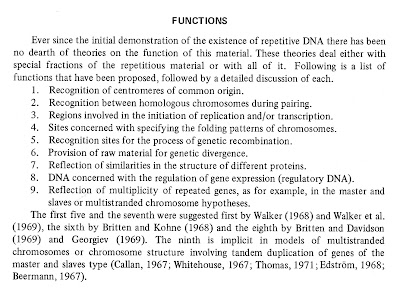
None of the recognition functions, i.e., recognition of centromeres, initiation sites, pairing sites, recombination sites, folding sites, or regulatory sites, that we have discussed is mutually exclusive of the others. They all relate to cellular phenomena that have been demonstrated or inferred from other data. All these phenomena probably exist within every higher organism. Therefore, DNA involved in each of these functions could contribute in varying degrees to the repeated portion of the genome.

Bostock, C. 1971. Repetitious DNA. Advances in Cell Biology 2: 153-223.

There is no doubt, however, that the presence of satellite DNA confers some selective advantage; otherwise we cannot account for its spread throughout a population as large as that of the house mouse.
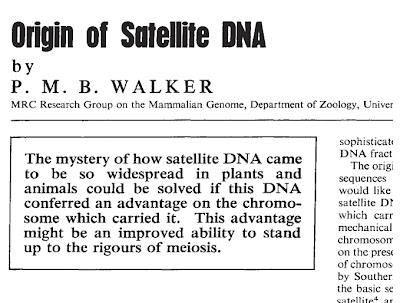

The origin and spread through the population of such diverse sequences therefore present considerable problems, and I would like to suggest that the best explanation might be that satellite DNA confers a direct advantage on the chromosome which carries it, because such a chromosome survives the mechanical processes of, primarily, meiosis better than a sister chromosome not so well endowed.

Walker, P.M.B. 1971. Origin of satellite DNA. Nature 229: 306-308.

With the assumption that a portion that comprises some 10 percent of the genomes in higher organisms cannot be without a raison d’être, an extensive review led us to conclude that a certain amount of constitutive heterochromatin is essential in multicellular organisms at two levels of organization, chromosomal and nuclear. At the chromosomal level, constitutive heterochromatin is present around vital areas within the chromosomes. Around the centromeres, for example, heterochromatin is believed to confer protection and strength to the centromeric chromatin. Around secondary constrictions, heterochromatic blocks may ensure against evolutionary change of ribosomal cistrons by decreasing the frequency of crossing-over in these cistrons in meiosis and absorbing the effects of mutagenic agents. During meiosis heterochromatin may aid in the initial alignment of chromosomes prior to synapsis and may facilitate speciation by allowing chromosomal rearrangement and providing, through the species specificity of its DNA, barriers against cross-fertilization.

At the nuclear level of organization, constitutive heterochromatin may help maintain the proper spatial relationships necessary for the efficient operation of the cell through the stages of mitosis and meiosis. In the unicellular procaryotes, the presence of a small amount of genetic information in one chromosome obviates the need for constitutive heterochromatin and a nuclear membrane. At higher levels of organization, with an increase in the size of the genome and with evolution of cellular and sexual differentiation, the need for compartmentalization and structural components in the nucleus became imminent. The portion of the genome that was concerned with synthesis of ribosomal RNA was enlarged and localized in specific chromosomes, and the centromere became part of each chromosome when the mitotic spindle was developed in evolution. Concomitant with these changes in the genome, repetitive sequences in the form of constitutive heterochromatin appeared, probably as a result of large-scale duplication. The repetitive DNA’s were kept through natural selection because of their importance in preserving these vital regions and in maintaining the structural and functional integrity of the nucleus.

The association of satellite (or highly repetitive) DNA with constitutive heterochromatin is understandable, since it stresses the importance of the structural rather than transcriptional roles of these entities. Nuclear satellite DNA’s have one property in common despite their species specificity, namely heterochromatization. In this sense the apparent species specificity of satellite DNA may be the result of natural selection for duplicated short polynucleotide segments that are nontranscriptional and can be utilized in specific structural roles.

Yunis, J.J. and W.G. Yasmineh. 1971. Heterochromatin, satellite DNA, and cell function. Science 174: 1200-1209.

The great variability between species (and even populations) in the type and quantity of satellite and/or cryptic sequence DNA suggests that organisms function within wide limits for organizing the type and extent of constitutive heterochromatin. On the other hand, the striking species specificity of major satellite sequences, together with a rather low level of base sequence divergence within a species and the precise localization of much of this DNA to centric heterochromatin, suggest that these DNA’s perform important nuclear functions.

Rae, P.M.M. 1972. The distribution of repetitive DNA sequences in chromosomes. Advances in Cell and Molecular Biology 2: 109-149.

Today there are over 100 laboratories studying different aspects of the problem concerning highly repetitive sequences and, as is always the case, a new and often confusing jargon has grown up around the rapidly evolving field. It is the purpose of this chapter to define and describe these new terms and to focus on the following three questions: What are highly repetitive sequences? How did they evolve? What is their function?

Flamm, W.G. 1972. Highly repetitive sequences of DNA in chromosomes. International Review of Cytology 32: 1-51.

[Satellite DNAs in mice] are widely established in populations throughout the world and thus clearly cannot be relegated to a random and functionless quirk of evolution. Simple-sequence DNAs must obviously possess a certain role in the genome.

There is one major hope for making sense of the fact that many higher organisms seem to carry in every nucleus a large portion of their DNA that looks, superficially, to be completely worthless. This lies in the comparative approach. When do simple-sequence DNAs arise in evolution? Can we find two closely related species one with and one without a major block of heterochromatin?

Swift, H. 1973. The organization of genetic material in eukaryotes: progress and prospects. Cold Spring Harbot Symposia on Quantitative Biology 38: 963-979.

Alternatively, large variations in genome size could readily be accommodated if a high proportion of the DNA were used for functions other than coding for proteins. A number of such functions have been proposed and incorporated into hypothetical structures for the eukaryotic genome.

The outstanding problem presented by eukaryotic DNA is that of finding a role for these large fractions not used in coding for proteins or cytoplasmic RNAs.

Southern, E. 1974. Eukaryotic DNA. In MTP International Review of Science, Biochemistry Series One, Volume 6, Biochemistry of Nucleic Acids (ed. K. Burton), pp. 101-139. University Park Press, Baltimore.

Genetic redundancy is common in eukaryotes and thus must confer substantial selective advantages upon this group of organisms. One function of certain redundant DNA sequences (satellite DNAs) that are located in the centromeric heterochromatin may be to facilitate proper chromosome pairing and segregation.

Tartof, K.D. 1975. Redundant genes. Annual Review of Genetics 9: 355-385.

Proposed functions for satellite DNA were evaluated and formally set forth by Walker (1971) and have since been expanded by Mazrimas and Hatch (1972), Lagowski et al. (1973), Lee (1975), Bostock (1971), Walker (1972), and Comings (1972). In a masterful summary and evaluation of current ideas relating repeated DNA to the organization of the eukaryote chromosome (Cold Spring Harbour Symposia on Quantitative Biology 1973) Swift stated that the function of simple sequence DNAs not only appeared to have most investigators mystified, but that the present theories concerning their function were not accepted with much enthusiasm. He did, however, point out that “There is one major hope for making sense of the fact that many higher organisms seem to carry in every nucleus a large portion of their DNA that looks superficially to be completely worthless. This lies in the comparative approach. When do simple sequence DNAs arise in evolution? Can we find two closely related species one with and one without a major block of heterochromatin?”

Miklos, G.L.G. and R.N. Nankivell. 1976. Telomeric satellite DNA functions in regulating recombination. Chromosoma 56: 143-167.

Satellites constitute from 1% to 65% of the total DNA of numerous organisms, including that of animals, plants, and prokaryotes. Their existence has been known for about 15 years, but, although it is thought that they must be biologically important, with few exceptions … their functions are still largely in the realm of speculation. This remains true despite their ubiquity and, except for polytenized tissues, their constancy as a fraction of the total DNA in all tissues of the particular animal or plant species in which they are observed.

Skinner, D.M. 1977. Satellite DNA’s. BioScience 27: 790-796.

The most important aspect of satellite DNA remains the nature of its functions. Although a large body of data has been gathered concerning its structure, distribution and properties in several different organisms, most of these results have in fact neither supported nor disproved any one of the particular hypotheses of function (see Comings, 1972; Swift, 1973; Hsu, 1975; Miklos and Nankivell, 1976; for evaluations of functions). The most popular hypothesis on satellite DNA function has been, and still is, that satellite DNA is involved in some aspect of chromosome mechanics such as chromosome pairing.

Yamamoto, M. and G.L.G. Miklos. 1978. Genetic studies on heterochromatin in Drosophila melanogaster and their implications for the functions of satellite DNA. Chromosoma 66: 71-98.

In spite of the large amount of information which now exists on the structure of satellite DNA, it is clear that the central issue, namely, function, has not been directly tackled. Probably the most important reason for this unsatisfactory state of affairs has been the signal failure to approach the problem of function experimentally, despite the considerable effort that has gone toward elucidating structural properties. In part this refractory state of affairs stems from the assumption that a knowledge of function necessarily follows from a knowledge of structure. In part too it is explained by the fact that the properties of satellite DNA have been evaluated within the framework of prokaryotic dogma without sufficient consideration of the higher-order phenomena which characterize the biology of eukaryotes.

It appears very obvious that we have now reached a stage in satellite DNA research where additional structural analyses are not revealing the nature of its function — and indeed there is a very good reason for this. The initial success of the prokaryotic approach to genetic function was due to its manipulative aspects. This approach, involving perturbation of a system by mutation, deletion, substitution and translocation, proved critical. Only recently has a similar approach been applied specifically in investigating satellite DNA function, although an enormous literature exits on experimental and natural modifications of heterochromatin, which bear directly on this issue.

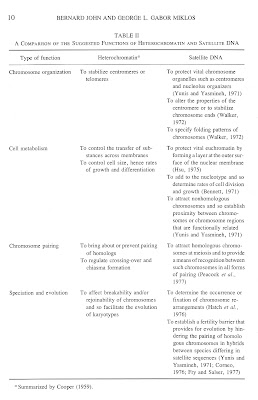
In the absence of experimental evidence the problem has in general been discussed in terms largely modified from earlier theoretical considerations relating to the functions of heterochromatin. A summary of the comparisons of heterochromatin and satellite DNA functions is presented in Table II. As can be seen from this table, the assumption has generally been made that there is at least one positive function. However, since similar organisms have widely different amounts of satellite DNA, and since such differences are found even between species that form viable hybrids, some investigators have suggested that these sequences are simply evolutionary by-products with no particular function. This fails to explain why so many eukaryotes have been found to contain highly repeated DNA and why its amount varies so considerably even between closely related species. Equally difficult to explain is why in some cases mechanisms have evolved to regulate replication of this DNA in particular tissues independently of the rest of the genome or indeed of other repetitious sequences in the same nucleus. Thus the large amount of satellite DNA in some species, its apparent rigid conservation in sequence and, as we shall see, its effects on the genome when it is altered in amount or position lead us to be unimpressed in general with the argument that most of it constitutes a functionless burden which many eukaryotes must bear. However, for the moment we will retain an open mind and examine the hard data pertaining to function before casting a final judgment at the end of this article.
Click for larger image

John, B. and G.L.G. Miklos. 1979. Functional aspects of satellite DNA and heterochromatin. International Review of Cytology 58: 1-114.

____________

Part of the Quotes of interest series.

Quotes of interest — Alu.

Whereas each copy of the human genome contains about 20,000 protein-coding genes, it is also home to more than 1 million copies of a short interspersed repetitive element (SINE) known as Alu. For this reason, Doolittle (1997), perhaps only half jokingly, suggested that the genomes of humans “might be ironically viewed as vehicles for the replication of Alu sequences”.

Alu elements are now known to be transposable elements and are restricted to primate genomes, though neither of these facts was recognized until several years after they were first discovered. They are not capable of autonomous movement and replication in the genome, rather they are “parasites” of other elements like LINE-1 which encode their own means of transposition. Their origin seems to trace to a duplication of a 7SL RNA gene near the origin of the primates. Today, some Alus are implicated in genomic functions while others continue to cause disease — as a general group of sequences, some are parasitic, some are mutualistic, and many are probably commensal, neither conferring benefit nor doing harm. For an excellent overview the biology of Alu elements, see Batzer and Deininger (2002).

The history that is most commonly recounted when it comes to the study of genomic components like pseudogenes and transposable elements is that they were long dismissed as irrelevant “junk”. As I noted with reference to pseudogenes, they were not interpreted this way when discovered, even though this happened 5 years after the idea of “junk DNA” was proposed (Jacq et al. 1977).

Alu elements were first isolated in 1979, and are so named because this involved digestion of genomic DNA with the AluI restriction enzyme (which in turn is named for the bacterium from which it is derived, Arthrobacter luteus) (Houck et al. 1979). Again, if the typical story about noncoding DNA is true, then we should expect the discovery of these elements to have been discussed in terms of their biological insignificance.

Here is what Houck et al. (1979) actually said about the newly discovered elements:

Renatured DNA from human and many other eukaryotes is known to contain 300-nucleotide duplex regions from renatured repeated sequences. These short repeated DNA sequences are widely believed to be interspersed with single copy DNA sequences. In this work we show that at least half of these 300-nucleotide duplexes share a cleavage site for the restriction enzyme AluI. This site is located 170 nucleotides from one end. This Alu family of repeated sequences makes up at least 3% of the genome and is present in several hundred thousand copies.

Since these 300-nucleotide sequences, as well as their interspersed unique sequences, occupy such a large fraction of the genome in widely divergent eukaryotes, one imagines that they serve some important biological function. Among other possibilities, it has been proposed that they are involved in gene regulation. Unfortunately, their function remains unproven. In deciding what biological function these repeated sequences might serve, it is important to know the number of different families to which they belong.

It has been proposed that the 300-nucleotide interspersed repeated sequences perform a regulatory function either at the DNA or RNA level. The inclusion of over half of these 300-nucleotide sequences in a single family of repetitive sequences (the Alu family) would limit their ability to function as complex regulatory elements.

We have found in this work that at least half of 300-nucleotide inverted repeated DNA sequences and half of all other 300-nucleotide repeated sequences belong to one family. Comparing our independent results on inverted repeated DNA sequences, it seems likely that the heterogeneous nuclear RNA duplexes studied by Jalinek are transcribed from the Alu family of repeated sequences. We are currently testing this hypothesis by RNA-DNA hybridization and DNA sequencing. This hypothesis suggests that the function of the Alu family occurs at the level of the heterogeneous nuclear RNA. It has been proposed that such repeated sequences might be processing sites for heterogeneous nuclear RNA. Although other possibilities cannot be ruled out at this time, we find this to be an especially attractive proposal for the function of a single simple class of repeated sequences that are so widely distributed throughout the genome.

In a second paper published in the following year, Rubin et al. (1980) said:

The biological function of this family of sequences is unknown. We and our colleagues have recently noted sequence similarities between a selected portion of the Alu family and several other RNA or DNA sequences, which are known or suspected to be involved in DNA replication, transcription control, and mRNA processing. Together these observations reinforce our belief that a family of DNA sequences which includes 300,000 highly conserved members interspersed throughout much of the mammalian genome, must have an important function.

____________

Part of the Quotes of interest series.
____________

Batzer, M.A. and P.L. Deininger. 2002. Alu repeats and human genomic diversity. Nature Reviews Genetics 3: 370-380.

Doolittle, W.F. 1997. Why we still need basic research. Annals of the Royal College of Physicians and Surgeons of Canada 30: 76-80.

Houck, C.M., F.P. Rinehart, and C.W. Schmid. 1979. A ubiquitous family of repeated DNA sequences in the human genome. Journal of Molecular Biology 132: 289-306.

Jacq, C., J.R. Miller, and G.G. Brownlee. 1977. A pseudogene structure in 5S DNA of Xenopus laevis. Cell 12: 109-120.

Rubin, C.M., C.M. Houck, P.L. Deininger, T. Friedmann, and C.W. Schmid. 1980. Partial nucleotide sequence of the 300-nucleotide interspersed repeated human DNA sequences. Nature 284: 372-374.