Birds and dinosaurs, collagen, and Huxley.

I have already blogged about this topic in a short post [Yet another link between dinosaurs and birds], so I will just point out the existence of another paper along these lines using phylogenetic analyses of collagen amino acid sequences recovered from T. rex fossils to demonstrate a close affinity between theropod dinosaurs and birds (Organ et al. 2008), a link first proposed by T.H. Huxley in 1868. This newest analysis was led by Chris Organ, who also did the dinosaur cell/genome size estimation study (Organ et al. 2007; Zimmer 2007). They also looked at mastodons. The data from mastodons and dinosaur aren’t new (Asara et al. 2007; Schweitzer et al. 2007) — the main update is the inclusion extant species and of a phylogenetic component.


There are plenty of news stories about it, including the following.

Molecular Analysis Confirms Tyrannosaurus Rex’s Evolutionary Link To Birds (ScienceDaily)

From T. Rex to Chicken: The Dino-Bird Connection(Discovery News)

T. rex confirmed as great granddaddy of all birds (New Scientist)

Phylogenetic Tree: Dinosaurs, Alligators And … Ostriches? (Scientific Blogging)

Gunk in T. Rex Fossil Confirms Dino-Bird Lineage (LiveScience)

Finally, a reminder about how species names should be listed.
_______

References

Asara, J.M., M.H. Schweitzer, L.M. Freimark, M. Phillips, and L.C. Cantley. 2007. Protein sequences from mastodon and Tyrannosaurus rex revealed by mass spectrometry. Science 316: 280-285.

Huxley, T.H. 1868. On the animals which are most nearly intermediate between birds and the reptiles. Annals and Magazine of Natural History, Series 4, 2: 66-75.

Organ, C.L., A.M. Shedlock, A. Meade, M. Pagel, and S.V. Edwards. 2007. Origin of avian genome size and structure in non-avian dinosaurs. Nature 446: 180-184.

Organ, C.L., M.H. Schweitzer, W. Zheng, L.M. Freimark, L.C. Cantley, and J.M. Asara. 2008. Molecular phylogenetics of mastodon and Tyrannosaurus rex. Science 320: 499.

Schweitzer, M.H., Z. Suo, R. Avci, J.M. Asara, M.A. Allen, F.T. Arce, and J.R. Horner. 2007. Analyses of soft tissue from Tyrannosaurus rex suggest the presence of protein. Science 316: 277-280.

Zimmer, C. 2007. Jurassic genome. Science 315: 1358-1359.


Shedding light on Darwin.

Apparently shedding light on Darwin (for photography) is difficult.

Not enough:


Too much:


Incidentally, this statue of Darwin is located next to a small cafe at the back end of the first floor at the Natural History Museum in London. In the main hall, halfway up the central staircase and overlooking the reconstruction of Dippy (Diplodocus carnegii), is a bronze statue of Richard Owen. It seems the Natural History Museum forgot to expel this vocal opponent of “Darwinism”. I suppose the fact that he did real research and founded a real museum (namely, the NHM) had something to do with it.


Hiroshima.

The Skeptical Alchemist posted this video, which has some significance for me since I was in Hiroshima less than 2 weeks ago.

Say what you want about the need to end the war, the expected casualties during an invasion, or whatever other rationalizations you like. But consider this question, by Leó Szilárd:

“Suppose Germany had developed two bombs before we had any bombs. And suppose Germany had dropped one bomb, say, on Rochester and the other on Buffalo, and then having run out of bombs she would have lost the war. Can anyone doubt that we would then have defined the dropping of atomic bombs on cities as a war crime, and that we would have sentenced the Germans who were guilty of this crime to death at Nuremberg and hanged them?”


My growing respect for New Scientist.

I have said some nice things about New Scientist, such as noting that they printed one of the best popular treatments of “junk DNA” I have read [New Scientist gets it right]. On the other hand, I also criticized one of their headlines as perpetuating misconceptions about how evolution works [Chimps are not more evolved than humans or anyone else]. Today, New Scientist shows that they are far more worthy of endorsement than nitpicking in their publication of a special issue on evolution. Not only this, but the online version of one of the articles links to my aforementioned criticism, which I consider very decent.

My local bookstore does not have the April 19 issue yet, so I have not seen the print version, but their collection of 24 myths and misconceptions can be accessed freely online:

Shared misconceptions:

Everything is an adaptation produced by natural selection

Natural selection is the only means of evolution

Natural selection leads to ever-greater complexity

Evolution produces creatures perfectly adapted to their environment

Evolution always promotes the survival of species

It doesn’t matter if people do not understand evolution

“Survival of the fittest” justifies “everyone for themselves”

Evolution is limitlessly creative

Evolution cannot explain traits such as homosexuality

Creationism provides a coherent alternative to evolution

Creationist myths:

Evolution must be wrong because the Bible is inerrant

Accepting evolution undermines morality

Evolutionary theory leads to racism and genocide

Religion and evolution are incompatible

Half a wing is no use to anyone

Evolutionary science is not predictive

Evolution cannot be disproved so is not science

Evolution is just so unlikely to produce complex life forms

Evolution is an entirely random process

Mutations can only destroy information, not create it

Darwin is the ultimate authority on evolution

The bacterial flagellum is irreducibly complex

Yet more creationist misconceptions

Evolution violates the second law of thermodynamics

[Tipped hats to Panda’s Thumb and Sandwalk]


Primitive versus [blank].

Wilhelm Johannsen, who coined such terms as “gene”, “genotype”, and “phenotype”, noted in 1911 that,

It is a well-established fact that language is not only our servant, when we wish to express – or even to conceal – our thoughts, but that it may also be our master, overpowering us by means of the notions attached to the current words.

Even widely used and (apparently) simple terms can cause substantial confusion when the notions attached to them are unwarranted, a problem that is particularly common in evolutionary biology. Think “theory“, a term that is not only poorly understood to begin with in its scientific context but is actively misrepresented by anti-evolutionists.

The misinterpretation of other terms may cause, or be caused by, particular assumptions about the nature of the evolutionary process. Take the term “primitive” for example. The use of the term can be either deeply misleading or entirely appropriate depending on what one considers to be the opposite of the term. Here are the two most common uses, the first problematic and the second legitimate.

1) Primitive versus advanced.
In this comparison, the term “primitive” has pejorative connotations of inferiority relative to “more evolved” species. Evolution is implied to be a progressive process characterized by improvement rather than simply of change. This is the usage one finds in popular media, for example in the all-too-well-known “evolutionary line-up” showing progressive improvement in anything from primate species to any manner of product being advertised as new and improved. However, biological evolution is not a progressive process, and this use of the term is inappropriate.

2) Primitive versus derived.
In technical parlance, “primitive” can be used to mean that one form of a trait is “more like a common ancestor” relative to another form of the trait (i.e., as synonymous with “ancestral”). It is an expression of the differential quantity of change that has occurred since two or more lineages diverged. The opposite of primitive in this usage is not “advanced” but “derived”. There is no automatic implication that change has been progressive in this sense.

So, one should not draw a comparison between “primitive versus advanced”, but “primitive versus derived” is not problematic. It bears noting, though, that the terms primitive (or ancestral) and derived are actually applicable to particular characters, not to entire organisms. As Crisp and Cook (2005) noted,

Once two lineages have separated, each evolves new characters independently of the other and, with time, each will show a mixture of plesiomorphic [inherited largely unchanged from the ancestor] and apomorphic [newly evolved and thus not possessed by the ancestor] character states. Therefore, extant species in both lineages resemble, to varying degrees, their common ancestor. Consequently, whereas character states can be relatively ancestral (plesiomorphic) or derived (apomorphic), these concepts are nonsensical when applied to whole organisms.

_______

Crisp, M.D. and L.G. Cook. 2005. Do early branching lineages signify ancestral traits? Trends in Ecology and Evolution 20: 122-128.

Johannsen, W. 1911. The genotype conception of heredity. American Naturalist 45: 129-159.


Phylogenetic fallacies: "branching from a main line".

In my previous post, written in response to a more egregious fallacy about evolutionary trees presented in a science news story, I focused on the misconception that an “early branching” lineage was necessarily “primitive” (i.e., very similar to a distant ancestor). This time, I want to discuss something slightly more subtle, but nonetheless important, with regard to interpreting phylogenies. Specifically, I want to note a problem with the very concept of one lineage “branching off from” another lineage.

There can be a tendency to consider evolutionary trees as reflecting a main line with a series of “side branches”. This is especially true when the tree is “unbalanced” (lineages are depicted with uneven amounts of diversity) and “ladderized” (the more diverse branches are placed on the same side of each node). The following is a general unbalanced, right-ladderized tree.


This sort of diagram is often interpreted as implying that there is a “main line” leading from a distant ancestor up through time to species A, and that the lineages now represented by species H, G, F, E, D, C, and B “branched off” from this main line earlier or later, in that order. However, one can just as accurately represent this phylogeny with several of the branch points (nodes) rotated with no effect on the order of branching (topology), as shown in the next figure. A is still closest to B, then C, then D, and so on, just as with the previous representation.

Looking at the most recent split, between A and B, in this version of the phylogeny, it would not make much sense to argue that one branched off from the lineage of the other — they are both derived from a common ancestor from whom their respective lineages diverged at the same time. Likewise, the lineage leading to H did not branch first off a main lineage leading to A, rather it and the lineage that ended up leading to G and all the other species split into two.

Looking at a real example, one can see how the main line fallacy creeps in when interpreting evolutionary trees. Here is a phylogeny showing the relationships among several lineages of vertebrates, namely cartilaginous fishes, some bony fishes, and some tetrapods. It might be tempting to see this as indicating that sharks branched first, then bony fishes, then amphibians, then birds.
This, like the abstract trees presented previously, is unbalanced and ladderized. Humans are placed at one end, as they usually are (even though this is an arbitrary decision — birds could just as accurately assume the rightmost position by rotating their shared node). However, notice what happens when we rotate some nodes and change the sampling of species presented in the phylogeny. In this case, sharks, humans, frogs, and bony fishes are included, but the diversity of bony fishes, which make up about half of all vertebrates, is slightly better reflected.
If one were to interpret the revised phylogeny in the same way as the first one, then one would conclude that sharks branched first from the main line leading to perch, then the lineage leading to humans and frogs, then the lineage represented by trout, then the one represented by goldfish.

The point here is that one can only talk about which lineages “branched first” when one has a main line in mind from which other lineages can be considered side tracks. In the case of the “earliest branching animals” discussed in the last post, the lineage now represented by ctenophores and the one that ended up including all the other living animal lineages would simply have split from a common ancestor, and at the time it would not have been possible to identify either line as a branch off the other.

________

Images from Gregory TR. 2008. Understanding evolutionary trees. Evolution: Education and Outreach 1: 121-137.


Phylogenetic fallacies: "early branching equals primitive".

Evolutionary trees, or “phylogenies”, are a major part of modern evolutionary science. They depict hypotheses regarding the relationships among taxa, and are therefore important in reconstructions of the historical path of evolution (Gregory 2008a,b). Various approaches can be taken to formulating phylogenetic hypotheses, including analyses based on morphological, fossil, and/or molecular data. These methods often agree well, but sometimes one or another can throw up some surprises and challenge previous hypotheses about the relationships among groups of organisms. Reconstructing the tree of life is a difficult and complicated process, and one should expect there to be significant refinements and revisions along the way. This is especially true of the deepest branches of the tree, which are often the most difficult to resolve.

Case in point, the Tree of Life Web Project gives the following summary of deep branches among major animal lineages:
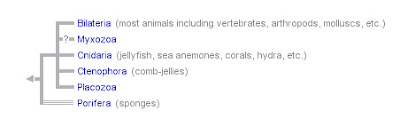
Two things are apparent from this phylogeny. First, most of the branchings (“nodes”) are unresolved at the deepest point. This is known as a “soft polytomy”, meaning that these lineages probably did not emerge all at the same time from a distant ancestor, but rather that the data simply are not sufficient at present to determine the order of their branching. Second, sponges (Phylum Porifera) are typically considered to represent descendants of the earliest branching lineage.

Sponges are simple, sessile, filter-feeding animals comprised of only a handful of cell types. It has commonly been suggested that they retain characteristics similar to those of some of the earliest animals to appear. In other words, even though they are modern species, it is thought that their simplified morphology reflects the ancestral condition, having undergone little change over hundreds of millions of years of evolution.

Recently, a study by Dunn et al. (2008) using a comparatively large genetic dataset suggested something of a shake-up of the evolutionary tree at the deepest branches. Specifically, their data suggested that comb jellies (Phylum Ctenophora), rather than sponges, are modern representatives of the earliest branching lineage.
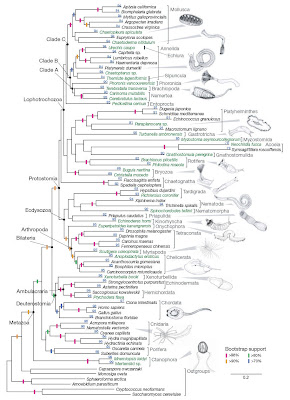
From Dunn et al. (2008). Click for larger view.

Ctenophores are superficially similar to jellyfish, and are much more complex than sponges. On the face of it, finding that ctenophores are descended from the earliest-branching animals is surprising. However, this should not be taken too far, as it has in some of the press surrounding the article. For example, LiveScience presented a report entitled “Shock: First animal on Earth was surprisingly complex“. As they describe the situation,

Earth’s first animal was the ocean-drifting comb jelly, not the simple sponge, according to a new find that has shocked scientists who didn’t imagine the earliest critter could be so complex.

This interpretation illustrates a common misconception about evolutionary trees, one that I addressed in a recent paper on the topic (Gregory 2008b). Specifically, it draws the false conclusion that a modern member of an early branching lineage is very similar to the distant ancestor that it shares with other lineages. In actuality, the species under consideration are all modern species whose lineages have been evolving for exactly the same amount of time since their divergence from a common ancestor. The comb jelly lineage may have branched first, but the common ancestor from which it and the other animals lineages diverged probably looked nothing like a comb jelly. It is entirely possible that comb jellies are highly derived (i.e., very different from their early ancestor), just as other animal lineages are.

Consider the phylogeny below, which presents relationships among the living groups of echinoderms:
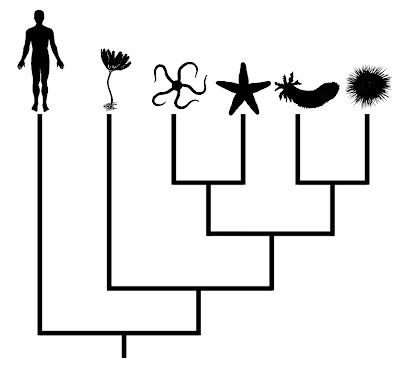
From Gregory (2008b).

In this case, humans are presented as the outgroup of the tree. Even though humans are shown as having branched earliest in this phylogeny, one cannot conclude that they look anything like the common ancestor shared by vertebrates and echinoderms. Unfortunately, this sort of misinterpretation is not uncommon for less obvious comparisons, even in the primary literature (Crisp and Cook 2005).

Dunn et al. (2008) provide a very reasonable interpretation of the data that does not mesh with that presented in the opening of the LiveScience report:

The placement of ctenophores (comb jellies) as the sister group to all other sampled metazoans is strongly supported in all our analyses. This result, which has not been postulated before, should be viewed as provisional until more data are considered from placozoans and additional sponges. If corroborated by further analyses, it would have major implications for early animal evolution, indicating either that sponges have been greatly simplified or that the complex morphology of ctenophores has arisen independently from that of other metazoans.

This is to say, one cannot take the finding as well established without further data, and even if it is corroborated it simply means that either ctenophores evolved their level of complexity independently of other animal lineages (i.e., the common ancestor was simple), or sponges are secondarily simplified (i.e., the common ancestor was fairly complex). Neither scenario is especially shocking, given that the sponges and comb jellies being studied are modern groups.

Strangely enough, the LiveScience story includes this information, but the implications of it apparently were not grasped:

Dunn says that two evolutionary scenarios can explain why the comb jellies would actually have been first among animals. The first is that the comb jelly evolved its complexity independent of other animals after branching off to forge its own path.

The second is that the sponge evolved its simpler form from the more complex form. This second possibility underscores the fact that “evolution is not necessarily just a march towards increased complexity,” Dunn said.

The first animals probably were not very similar to comb jellies as we now know them, namely as representatives of a lineage that has been evolving for hundreds of millions of years since diverging from those of other major animal groups. Sponges, too, have been evolving for hundreds of millions of years, and there is no reason to assume that they have not undergone any significant morphological changes in that time. Molecular data provide insights into the order of branching, but fossils are required in order to reach conclusions about morphological change or lack thereof over evolutionary timescales.

In short, one cannot assume that a modern representative of an early branching lineage is the same as the ancestor from which it is descended.

_______

Crisp, M.D. and L.G. Cook. 2005. Do early branching lineages signify ancestral traits? Trends in Ecology and Evolution 20: 122-128.

Dunn, C.W., A. Hejnol, D.Q. Matus, K. Pang, W.E. Brown, S.A. Smith, E. Seaver, G.W. Rouse, M. Obst, G.D. Edgecombe, M.V. Sorensen, S.H.D. Haddock, A. Schmidt-Rhaesa, A. Okusu, R.M. Kristensen, W.C. Wheeler, M.Q. Martindale, and G. Giribet. 2008. Broad phylogenomic sampling improves resolution of the animal tree of life. Nature 452: 745-749.

Gregory, T.R. 2008a. Evolution as fact, theory, and path. Evolution: Education and Outreach 1: 46-52.

Gregory, T.R. 2008b. Understanding evolutionary trees. Evolution: Education and Outreach 1: 121-137.

______

Update:

See also Stranger Fruit and Nimravid. I should also have noted that this comparison only includes representatives of lineages that survived to the present. Ctenophores may be members of the earliest branching living lineage (I remain skeptical, mind you), but many lineages may have diverged earlier but subsequently vanished — again, this would mean that modern ctenophores were not the first animals (and, besides, it’s quite possible that the Ediacarans were the first animals but neither sponge nor ctenophore). And the whole notion of “diverged first” is somewhat misleading — there was a split and two lineages diverged from each other; one is not a side branch of a main line.

Thanks for the birthday wishes!

Just a quick thanks to everyone who has been wishing Genomicron a happy one year anniversary, either in the comments, or on their blogs. I’ll list them here for some link reciprocity:

If you have a link and I missed it, please let me know.