Darwin’s note on higher and lower.

Here is a page from Darwin’s 1837 notebook. (Click for larger image)

In case you can’t read his handwriting (few can), it says

It is absurd to talk of one animal being higher than another. We consider those, when the cerebral structure / intellectual faculties most developed, as highest. A bee doubtless would when the instincts were.

________________________
Get your Darwin Year gear here.

Worse than lower and basal.

Why can’t reports in the media accurately convey the basics of evolution? And why can’t scientists make a dedicated effort to clarify things whenever they give an interview? What hope is there for clarifying the most fundamental concepts when every story seems to reinforce misconceptions?

From the Discovery Channel:

Ancestor For All Animals Identified

A sperm-looking creature called monosiga is the closest living surrogate to the ancestor of all animals, according to new research that also determined animal evolution may not always follow a trajectory from simple to complex.

Yet another find of the study, published in the latest PLoS Biology, is that Earth may have given rise to two distinct groups of animals: bilaterians — animals with bilateral symmetry, like humans — and non-bilaterians, which include corals, jelly fish, hydra, unusual, often poisonous, creatures known as cubozoans, and other organisms.

Free-living, unicellular organisms called choanoflagellates, however, could be on every person’s family tree, so long as it was a gigantic one.

…

They determined that so-called “simple” and “lower” tier animals, such as corals and jellyfish, evolved in parallel to “higher” animals, like seemingly more complex insects and even humans. On the tree of life, monosiga then currently holds the root position for the latter group.

Please, let’s try to get this right from now on. No study reconstructing phylogenetic relationships between modern taxa tells you what the ancestor of those taxa was. It may provide some clues, but all species being examined are derived in some ways and primitive in others.

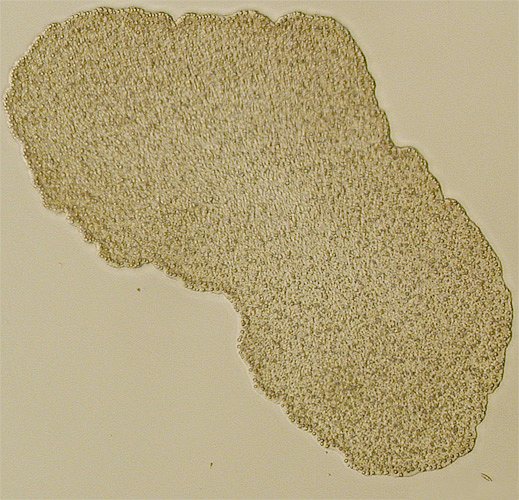
Trichoplax is not your ancestor.
You share a common ancestor with it.

No biologist who knows anything about evolution would suggest that evolution “always follow[s] a trajectory from simple to complex”. There is no such thing as “higher” and “lower”, though this pre-evolutionary idea apparently is hard to abandon.

And not every rearrangement of proposed evolutionary relationships is a revolution. Many of the deep nodes have been enigmatic for a long time, so it’s not a surprise when they move around based on improved information. Here is how I, an evolutionary biologist, react to each new molecular phylogeny that moves animal branches around:

“Neat. I wonder if it will hold up. It will be interesting to think about what this means in terms of major patterns.”

For a much better take on this new phylogeny written by someone with expertise, see Todd Oakley’s latest post. If we could just get more scientists to write blogs…

(Incidentally, the idea that the ancestors of animals were choanoflagellate-like organisms dates to the 19th century. I even parodied this well-known idea on a shirt).

________________________
Get your Darwin Year gear here.

Lower and basal.

The story:

New Tree Of Life Divides All Lower Metazoans From Higher Animals, Molecular Research Confirms

The response:

“It is absurd to talk of one animal being higher than another” (Charles Darwin, 1837)

More information:

Understanding evolutionary trees

(By the way, Rob DeSalle, who is quoted in the story, was one of my postdoc advisors and he definitely understands phylogenies — but the story is pretty sloppy nonetheless)

New Scientist takes the hype road.

The primary goal of a magazine is to sell magazines. However, if a magazine is about science and wishes to preserve its credibility as a source of science information (and thus, to sell magazines), it should do its best to avoid unnecessary hype, especially when this touches on sensitive issues in science policy or education.

Well, I am afraid to say that New Scientist, which I have previously praised for excellent, balanced coverage [here and here], now looks to be taking the hype road.

Look at these two recent cover stories.
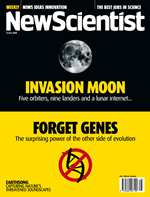
Forget genes? Really? This story was about epigenetics, and floated the idea that maybe evolution is Lamarckian after all. Nevermind the fact that they don’t seem to know what Lamarckian evolution actually is.
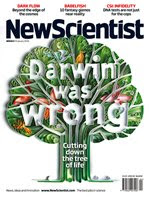
This one has, rightly, provoked the ire of many bloggers/scientists [see here, here, here, here, here, here, here, here, and here]. It is without question irresponsible, poorly timed, and sure to be invoked by anti-evolutionists, making the job of defending science and science education more difficult. The explanation offered by the author/editor for it is unacceptable.

Fundamentally, Darwin was right about his two big ideas that really matter: common descent and natural selection. To say “Darwin was wrong”, even within the article’s context, is nonsense. The fact that it will undoubtedly be taken to refer to the big ideas rather than a specific analogy makes it infuriatingly misleading.

Compare this with the approach taken by National Geographic.
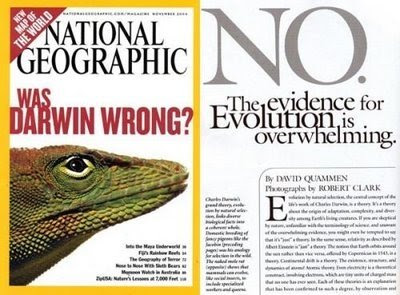
Pretty provocative cover, but still phrased as a question — and answered without ambiguity.

There is a lot that Darwin didn’t know, and I hope that the success of evolutionary biology in the 150 years since the Origin is talked about in abundance this year. But the fact that his two big ideas, common descent and natural selection, have survived every scientific discovery since the mid 1800s is overwhelmingly convincing that he was brilliant and insightful and right. (The associated story, Modern Darwins by Matt Ridley, is certainly worth reading.)

To be clear, I don’t think magazines should make decisions about their covers or articles solely on the basis of how anti-evolutionists might use them. But as communicators, they — and any scientists interviewed in popular articles — have a responsiblity to think about the implications of what they say.

As pointed out recently by Scott and Branch,

in science, we do not shape our research because of what creationists claim about our subject matter. But when we are in the classroom or otherwise dealing with the public understanding of science, it is entirely appropriate to consider whether what we say may be misunderstood.

I strongly encourage New Scientist to rethink the message that cover stories like this send.
Don’t call it Darwinism

For those of you who still are not reading Evolution: Education and Outreach, here’s another reason to check it out.

Eugenie Scott and Glenn Branch of the National Center for Science Education have a nice article coming out in the next issue entitled “Don’t call it Darwinism“. It is already free to access in preprint.

While you’re at it, you can have a look at the special issue on eye evolution, and my first contribution to a series entitled “Evolutionary Concepts” on artificial selection.

A farewell to Evolgen.

Well, it looks like Evolgen has decided to shut down indefinitely. I kept Evolgen on my feed list the whole time (plenty of others have been dropped, only a few re-added), and I enjoyed reading it. However, I can sympathize with blogging becoming a lower priority. Honestly, my posts have gotten fewer and farther between since last semester.

[rant]
I also was quite disappointed with the lack of response by the blogosphere to the special issue of E:EO on eye evolution, which I really thought would be of interest. (I think perhaps very few people read Genomicron anymore, after a sporadic updating for a few months).
[/rant]

So, anyway, farewell Evolgen, and I don’t blame you for leaving when you felt the blog had run its course.

More Darwin Year gear!

We have uploaded another set of designs for Darwin Year gear. Be sure to check out the shop (http://www.cafepress.com/darwinyear2009), and for additional stuff keep watching the related website which is still in progress.

If you have a blog, we would certainly appreciate a plug (remember, 50% of the proceeds go directly to charity, and the rest will be spent on developing evolution web resources).

Here are some more examples of what you can find there:

If you get it, you definitely deserve to wear it:
More quotations:


These I am really hoping will turn out on t-shirts:

Image spelled out using last paragraph of the Origin:

Matrix Darwin (again, text from the end of the Origin):


http://www.cafepress.com/darwinyear2009
http://www.darwinyear2009.com

Darwin Year gear!

Two years ago, I had t-shirts made up for my evolution course that depicted Darwin’s notebook sketch of a simple tree diagram capped by the words “I think”. In total, we generated about $500 for conservation charities, and the students got a pretty cool shirt (I still see them around campus fairly frequently). Had I been teaching the course this semester, I probably would have produced the t-shirts again. This is Darwin Year, after all. But I’m not, so I won’t.

Instead, I have teamed up with a good friend (and former fellow grad student) who is now a website designer and graphic artist to come up with a whole line of Darwin Year gear. We are planning to donate 50% of the proceeds directly to conservation charities, and the other 50% is to be invested in developing other evolution-related websites (hint: www.evolverzone.com and www.darwinaut.com). We’ve been having a lot of fun coming up with ideas, and we’ve also been working on a dedicated webpage with recommended books, links, and so on.

Our view is that Darwin Year is not just about Darwin, but is meant to be a celebration of the achievements of the entire scientific discipline that he helped to establish 150 years ago.

If you are looking for evolution-related shirts and other stuff, I invite you to check out the store at www.cafepress.com/darwinyear2009 or the main website www.darwinyear2009.com. Both of these are still under construction, and we’ll be producing many more designs in the near future. But you can already access quite a few designs.

What will you find? Here are some examples:

Front:

Back:


Word use in the Origin (one of many designs):

(Inspired by ERV🙂

www.cafepress.com/darwinyear2009
www.darwinyear2009.com